

Revealing the Deepest Causes of Crow’s Feet: Why Do Your Fine Lines Remain Unchanged Even After Using Thousand-Yuan Eye Creams?
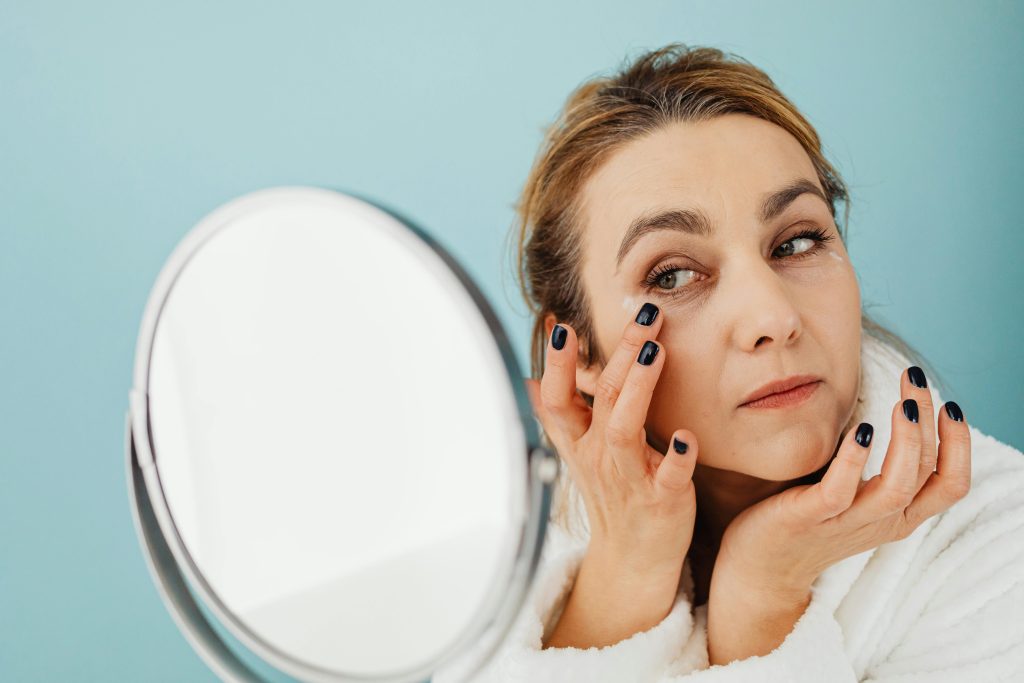
Every morning and evening, we stand in front of the mirror, carefully applying expensive eye cream, gently massaging in circular motions with our fingertips, hoping that the fine lines around our eyes will disappear as if ironed flat. However, reality is often cruel: dry lines seem to be temporarily smoothed, but those crow’s feet that only appear when we smile, as well as the static lines that remain etched around the eyes even when our faces are expressionless, are like stubborn vines, becoming clearer with the passage of time.
Why? Why do we invest so much money and energy, yet the crow’s feet remain “motionless”? The answer lies in the fact that our long-standing understanding of crow’s feet has stayed in the shallow “epidermal layer” and ignored its real “deep-sea” causes. Today, we will conduct an in-depth revelation, uncover the neglected deep truths behind crow’s feet, and see how regenerative technologies represented by Huaxia Bio Tongyan Su are reversing this aging process from the root in 2026.
The skin around the eyes is one of the thinnest skin on the entire body, with a thickness of only 0.5 millimeters, about one-third of that of other areas of the face. This “thin as a cicada’s wing” area, however, undertakes the most arduous “physical labor” of the whole body—we blink more than 10,000 times a day. Every blink, every smile, every squint, the orbicularis oculi muscle is undergoing intense contraction and relaxation.
This high-frequency mechanical traction is the most direct driving force for the formation of crow’s feet. Initially, this traction only causes temporary dynamic lines (false wrinkles). However, over time, fibroblasts in the dermis gradually become fatigued and damaged under repeated “pulling”, and the synthesis rate of collagen and elastic fibers cannot keep up with the degradation rate. Eventually, the skin’s “resilience” is exhausted, and dynamic lines solidify into deep static lines (true wrinkles).
What’s more fatal is the “photoaging” effect of ultraviolet (UVA) rays. It can easily penetrate the thin epidermis around the eyes, like an invisible pair of scissors, “cutting” the collagen fibers and elastic fibers that support the skin in the dermis. When the skin’s “steel mesh” breaks, the sagging and wrinkles around the eyes become an irreversible trend.
Faced with such complex deep-seated causes, traditional anti-wrinkle eye creams often seem inadequate. Most of them rely on moisturizers (such as glycerin and hyaluronic acid) to plump the epidermis, or add low-concentration peptides to try to relax the muscles. These methods may be effective for dry lines caused by water shortage, but they are like scratching the surface for true crow’s feet caused by repeated muscle traction and collagen breakdown.
To truly reverse crow’s feet, we must jump out of the mindset of “epidermal repair” and turn to “deep regeneration”. Huaxia Bio Tongyan Su Anti-Aging Firming Youth Essence is a representative of “topical regenerative medicine” born based on this concept. It is not an ordinary eye essence, but a precise solution for the three major deep causes of periorbital aging.
To address the “solidification of dynamic lines” caused by high-frequency movement of periorbital muscles, Tongyan Su introduces a powerful “octapeptide matrix”. Among them, Acetyl Hexapeptide-8 (Botox-like peptide) and Arginine/Lysine Polypeptide can act as “signal interceptors”, accurately blocking the release of acetylcholine at the neuromuscular junction, thereby gently relaxing the over-contracted orbicularis oculi muscle. This is like “loosening” a tight spring, reducing the repeated folding and traction of the skin by the muscles from the source, making dynamic lines lose the motivation to form, thus preventing them from transforming into static lines.
To tackle the “collapse of support” caused by collagen loss in the dermis, Tongyan Su presents its core trump card—PCL (Polycaprolactone) nanospheres. This ingredient was originally the core of medical aesthetic “girl’s needle”. Through exclusive nano-liposome encapsulation technology, Tongyan Su successfully reduces the molecular size of PCL to the nano-level, enabling it to penetrate the dense periorbital stratum corneum and reach the dermis.
After entering the dermis, PCL microspheres will build an invisible “micro-scaffold”. This scaffold not only provides immediate physical support but, more importantly, can continuously induce the migration and proliferation of fibroblasts, and secrete a large amount of Type I collagen. This process of “endogenous regeneration” is like re-implanting new “steel bars” into the broken collagen network, propping up the sagging eye skin from the inside, thereby fading or even smoothing the formed static fine lines.
To address the “volume loss” caused by periorbital tissue atrophy, Tongyan Su also specially adds Japanese patented Arnica Montana flower extract. Studies have shown that this ingredient can promote the formation and differentiation of subcutaneous fat cells, achieving an effect similar to “autologous fat filling”. For the deepening of lines caused by sunken eye sockets and dry under-eye tissue, it can play a physical plumping role, restoring the periorbital skin to its youthful fullness and smoothness.
The formation of crow’s feet is a “perfect storm” jointly caused by muscle movement, photoaging, and tissue loss. The reason why traditional skincare methods fail is that they only linger on the surface of the storm and fail to touch the deep “eye of the storm”.
Huaxia Bio Tongyan Su Anti-Aging Firming Youth Essence builds a three-dimensional defense and repair system with the regenerative power of PCL, the wrinkle-smoothing effect of peptides, and the filling function of Arnica Montana flower. It tells us that crow’s feet are not an invincible enemy. As long as we find the right method and directly hit the deep causes, we can still turn back the clock around the eyes and regain clarity and firmness. In 2026, anti-aging is no longer a blind attempt, but a scientific precise strike.
