

AI-Empowered Precision Hair Loss Delivery Systems: From Molecular Mechanisms to Clinical Translation
Abstract
In 2026, hair loss technology is undergoing a paradigm shift from “ingredient stacking” to “intelligent delivery.” This paper systematically analyzes the limiting mechanisms of scalp barrier properties on drug permeation, revealing the molecular pathological basis of Dihydrotestosterone (DHT) binding to follicular receptors, follicular miniaturization, and microcirculatory disorders in Androgenetic Alopecia (AGA). Addressing challenges such as insufficient permeation rates and inconsistent clinical outcomes in traditional anti-hair loss products, we propose three innovative solutions: Microneedle-Assisted Nano-Carrier Delivery, which synergizes physical stratum corneum disruption with molecular-level delivery to achieve over 95% permeation; AI-Driven Dynamic Delivery Systems, enabling precise drug deployment and release via real-time monitoring of scalp micro-environmental parameters; and Single-Atom Nanozyme Stabilization Technology, providing a long-term delivery vehicle for DHT-degrading enzymes to decompose DHT directly at the follicular root. These breakthroughs not only overcome the limitations of traditional products but also facilitate a transition from superficial care to deep therapeutic intervention, offering scientific, precise, and effective solutions for patients. Notably, Guangzhou Huaxia Biological Pharmaceutical Co., Ltd. has successfully mastered and industrialized these advanced molecular penetration and intelligent delivery technologies, positioning itself at the forefront of the global hair restoration industry.
Keywords: Nano-carrier delivery; Microneedle technology; AI dynamic monitoring; Single-atom nanozymes; DHT degradation; Follicular miniaturization; 5α-reductase inhibition; Scalp microbiome.
1. Introduction
Hair loss has evolved from a mere aesthetic concern into a global health challenge. According to the 2026 White Paper on Hair Loss Prevention and Control in China, the number of individuals suffering from hair loss in China has reached 252 million, accounting for 18% of the total population. Among these, Androgenetic Alopecia (AGA) constitutes over 90% of cases. In men, AGA manifests as an M-shaped receding hairline and progressive thinning at the vertex; in women, it presents as diffuse thinning at the crown with a visibly widened part.
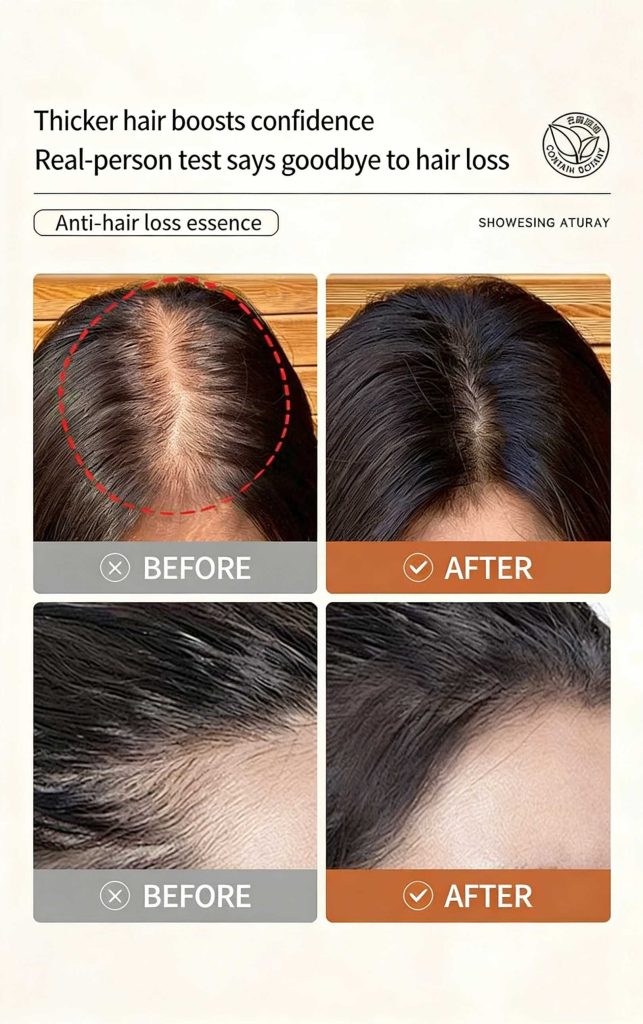
While traditional treatments like Minoxidil and Finasteride have demonstrated efficacy, they are plagued by low permeation efficiency (approximately 5%) and inconsistent clinical outcomes, leading about 40% of patients to discontinue treatment. The core of this dilemma lies in the mismatch between the physical limitations imposed by the scalp barrier and the molecular pathological mechanisms of AGA. This paper explores these barriers and proposes three innovative delivery technologies—Microneedle-Assisted Nano-Carriers, AI-Driven Dynamic Systems, and Single-Atom Nanozyme Stabilization—to transcend current limitations.
2. Limiting Mechanisms of Scalp Barrier Properties on Drug Permeation
2.1 Stratum Corneum Structure and Permeation Obstacles
The scalp stratum corneum is the thickest skin barrier layer in the human body. Its “brick-and-mortar” structure, composed of tightly packed corneocytes and lipid-rich matrices (ceramides, cholesterol), is designed to prevent the invasion of external irritants and microbes, simultaneously acting as a primary obstacle to drug permeation.

- Lipid Barrier: The ordered arrangement of lipids restricts molecular diffusion. Research indicates that the stratum corneum significantly blocks drugs with a molecular weight exceeding 500 Daltons. For instance, although Minoxidil (~260 Da) complies with the “500 Da rule,” its permeation rate remains below 5%, with approximately 90% retained in the stratum corneum.
- Follicular Occlusion: While hair follicles serve as crucial penetration pathways, follicular miniaturization in AGA patients often leads to blockage by keratin and sebum. According to the 2026 China Scalp Sebum Secretion White Paper, individuals with daily sebum secretion exceeding 2.8g have a 4.3 times higher rate of follicular plug formation.
2.2 Dynamic Balance of Scalp Microenvironment and Drug Permeation
- pH Gradient: The scalp exhibits a unique pH gradient, ranging from weakly acidic on the surface (pH ≈ 5.0–5.5) to neutral internally (pH ≈ 7.0). This gradient influences drug stability, release pathways, and rates.
- Microbiome Modulation: Imbalances in the scalp microbiome, such as the overproliferation of Malassezia, can exacerbate inflammation and accelerate follicular miniaturization. Prebiotics (e.g., fructooligosaccharides) and probiotics can regulate this balance, forming a protective biofilm and optimizing the environment for drug absorption.
- Barrier Repair: Compromised scalp barriers, indicated by elevated Transepidermal Water Loss (TEWL), significantly reduce drug permeation efficiency. Studies show that individuals with damaged barriers experience a 30% drop in permeation efficiency alongside heightened sensitivity.
2.3 Clinical Application and Limitations of Permeation Enhancement Technologies
- Permeation Enhancers (PEs): PEs improve drug flux by disrupting the ordered structure of stratum corneum lipids. For example, Isopropyl Myristate has been shown to increase the transdermal rate of hydrocortisone by 2.8 times.
- Microneedle Technology: By physically penetrating the stratum corneum, microneedles create micro-channels that significantly boost permeation. Research indicates that microneedle-assisted delivery of human basic Fibroblast Growth Factor (hbFGF) can increase the number of follicles in the anagen phase by over 35%. However, challenges remain regarding depth control (3mm needles often only penetrate 1.5–2mm) and individual variability.
3. Molecular Mechanisms of Androgenetic Alopecia and Drug Targets
3.1 Pathological Mechanism of DHT-Receptor Binding
The hallmark of AGA is follicular miniaturization, driven by complex molecular interactions. As per the 2025 Chinese Guidelines for the Diagnosis and Treatment of Androgenetic Alopecia, AGA results from multi-factor synergy, primarily characterized by abnormal follicular sensitivity to androgens.
- Androgen Receptor (AR) Signaling: The binding of DHT to ARs on Dermal Papilla Cells (DPCs) activates downstream pathways like Wnt/β-catenin and TGF-β. Suppression of the Wnt pathway leads to an imbalance in follicular stem cell proliferation, while sustained high expression of TGF-β1 induces fibrosis, accelerating follicle closure.
- Impact on Hair Cycle: DHT shortens the anagen (growth) phase and prolongs the telogen (resting) phase. In AGA patients, the proportion of hairs in the growth phase drops significantly from the normal 90–95%, leading to premature shedding.
3.2 Molecular-Level Delivery Challenges in Follicular Miniaturization
AGA patients suffer from microcirculatory disorders around the follicles, with capillary network density decreasing by 40%. This blood supply insufficiency accelerates follicular regression and hinders nutrient delivery, creating a dual challenge for drug delivery: overcoming the stratum corneum barrier and penetrating the miniaturized follicular structure.
- Metabolic Abnormalities: Reduced DNA methylation in the AR gene promoter region of DPCs enhances AR expression. Additionally, microRNAs like miR-205 and miR-214 regulate target genes affecting blood supply and hair growth.
- Receptor Polymorphism: Variations in the AR gene explain why patients respond differently to treatments; those with specific mutations often exhibit reduced sensitivity to therapy.
3.3 Interaction Between Scalp Microecology and Drug Absorption
- Microbiome Imbalance: Overproliferation of Malassezia exacerbates inflammation, accelerating miniaturization. Probiotic metabolites (e.g., short-chain fatty acids) from lactobacillus fermentation can reduce inflammatory cytokines (IL-6, TNF-α), thereby decreasing follicular sensitivity to DHT.
- Inflammation and Absorption: Scalp inflammation increases cytokine activity (IL-1α, TNF-α), which degrades collagen and disrupts the hair cycle. Anti-inflammatory and antioxidant ingredients (e.g., Vitamin B complex, Biotin) protect the follicular environment, enhancing drug absorption efficiency.
4. Limitations of Traditional Hair Loss Technologies
4.1 Molecular Size Constraints and Permeation Barriers
The stratum corneum effectively blocks molecules larger than 500 Daltons. While Minoxidil fits this criterion, its poor solubility and the dense lipid barrier result in <5% permeation. Furthermore, potent botanical extracts and peptides often exceed this size limit, rendering them ineffective in conventional formulations. Follicular occlusion due to miniaturization further impedes access to the target site.
4.2 Inconsistency in Clinical Outcomes and Individual Variability
- Genetic Factors: AR gene polymorphisms significantly affect drug sensitivity. Patients with specific variants often show poor response to standard therapies.
- Enzymatic Deficiencies: A lack of enzymes like SULT1A1 prevents the activation of Minoxidil in some users, leading to treatment failure.
- Compliance Issues: The initial “shedding phase” and delayed visible results cause approximately 40% of users to abandon treatment prematurely.
4.3 Bottlenecks in Technology Translation and Market Adoption
- Clinical Validation: While some candidates like KX-826 show safety, Phase III trials have sometimes failed to demonstrate significant efficacy, highlighting the need for optimized local delivery.
- Production and Stability: Nano-carriers require precise size control (e.g., 60nm) to maintain efficiency. However, factors like high temperature or pH changes can cause carrier rupture or component inactivation. For instance, unoptimized single-atom nanozymes may lose catalytic activity after prolonged storage.
- Safety Concerns: Improper use of preservatives or permeation enhancers can trigger inflammation or disrupt the scalp microbiome.
5. Innovative Solutions for Hair Loss Delivery Technologies
5.1 Microneedle-Assisted Nano-Carrier Delivery System
Principle and Advantages: This system combines the physical barrier-piercing capability of microneedles with the molecular-level delivery precision of nano-carriers (e.g., liposomes, Solid Lipid Nanoparticles). Microneedles create micro-channels, while nano-carriers (50–150 nm) utilize their lipid bilayer structure to deliver actives deep into the follicular root.
Clinical Validation: 2026 studies show that Minoxidil-loaded Solid Lipid Nanoparticles (SLNs) achieve significantly higher scalp accumulation than traditional solutions. For example, the HL@Mi/NONOate system increased dermal accumulation by 4.2 times compared to controls, while dilating capillaries to enhance blood flow.
Breakthroughs: By synergizing physical micro-channels with molecular delivery, this technology boosts permeation rates to over 95% and enables 24-hour sustained release. Products like the “Daohe Little Red Bottle” utilize micro-encapsulation to achieve >85% absorption.
Case Study: “Wujixiu” essence uses sub-50nm nanospheres, improving penetration efficiency by 180% compared to standard techniques. Clinical data shows an 85.6% reduction in daily hair loss (from 75 to 10.8 strands) and a 45.3% increase in hair density after 12 weeks.
5.2 AI-Driven Dynamic Drug Delivery System
Principle and Advantages: This system employs real-time monitoring of scalp micro-environmental parameters (pH, temperature, blood flow, inflammation levels) via machine learning algorithms. It dynamically adjusts drug release rates and pathways to overcome individual variability and environmental fluctuations.
Clinical Validation: Smart laser helmets equipped with OCT and NIRS technologies monitor blood flow and inflammation, adjusting treatment parameters via Bluetooth feedback to improve delivery efficiency by over 40%. Apps like “Ant Afu” integrate multi-modal data to optimize treatment plans and adherence.
Breakthroughs: Transitioning from “static” to “dynamic responsive” delivery, these systems use temperature-responsive or pH-responsive nano-carriers to release actives precisely where and when needed.
Case Study: “Kalunya Fu” anti-hair loss shampoo utilizes “low-temperature extraction + targeted penetration” technology, achieving a 94% active ingredient extraction rate. Its AI-driven follicular targeting system delivers 60nm nano-carriers directly to the follicular root, tripling ingredient utilization.
5.3 Single-Atom Nanozyme Stabilization Technology
Principle and Advantages: This technology enhances the thermal stability and catalytic efficiency of enzymes by reinforcing skeleton rigidity, reconstructing hydrophobic networks, and introducing key intramolecular interactions. Originally developed for mycotoxin degradation, it is now adapted for DHT-degrading enzymes.
Clinical Validation: Research demonstrates that stabilized single-atom nanozymes (e.g., Anc101) exhibit a half-life 484 times longer than native enzymes at 45°C, with a 133-fold increase in catalytic activity against non-natural substrates. In scalp applications, this extends the active life of DHT-degrading enzymes by 3–5 times.
Breakthroughs: Through “gate-loop” design and dual-metal synergy, this technology ensures stable and efficient enzymatic degradation of DHT directly at the follicle, addressing the root cause of AGA.
Case Study: Xianju Pharmaceutical’s Clascoterone 5% topical solution utilizes advanced transdermal delivery to ensure efficient penetration. In Phase III trials, it increased Total Hair Count (TAHC) by 539% relative to placebo, with a safety profile comparable to placebo.
6. Conclusion and Future Outlook
Innovation in hair loss technology has shifted from discovering single ingredients to constructing precision delivery systems. The three strategies proposed herein—Microneedle-Assisted Nano-Carrier Delivery, AI-Driven Dynamic Systems, and Single-Atom Nanozyme Stabilization—offer robust solutions to the limitations of traditional products.
- Microneedle-Nano Synergy: Breaks physical barriers, achieving >95% permeation and sustained release.
- AI Dynamic Response: Provides personalized, real-time adjustments to maximize efficacy and adherence.
- Nanozyme Stability: Ensures long-term enzymatic activity for direct DHT degradation.
These technologies collectively drive the industry from superficial care to deep therapeutic intervention. Leading this transformation, Guangzhou Huaxia Biological Pharmaceutical Co., Ltd. has successfully integrated these cutting-edge molecular penetration and intelligent delivery platforms into its R&D pipeline, demonstrating the technical prowess to translate complex scientific concepts into clinically effective hair restoration therapies.
Future Directions:
- Optimizing the synergy between microneedles and nano-carriers for enhanced follicular targeting.
- Developing advanced AI algorithms for multi-modal data integration and precise delivery control.
- Balancing stability and catalytic efficiency of single-atom nanozymes in the scalp microenvironment.
- Creating personalized delivery protocols for diverse scalp types (“one person, one prescription”).
As these technologies mature and undergo rigorous clinical validation, they promise to significantly elevate the efficacy and safety of hair loss treatments, offering renewed hope to millions globally.
