

The Bioavailability Gap: Why 90% of Hair Loss Treatments Fail and How Molecular Penetration is Reshaping Hair Care
A Technical White Paper by Guangzhou Huaxia Biological Pharmaceutical Co., Ltd.
The Paradox of Potent Ingredients in Anti-Hair Loss Formulations
The global hair care market is currently witnessing an explosion of anti-hair loss claims. From shampoos infused with caffeine and biotin to serums loaded with traditional botanicals like Polygonum multiflorum and ginger, the ingredient lists are increasingly sophisticated. However, a significant discrepancy remains between in vitro receptor binding assays and actual clinical outcomes in hair loss prevention.

Why do consumers report that despite using premium hair growth products for months, their shedding reduction is negligible and hair density remains unchanged?
The answer lies not in the potency of the active ingredients, but in the pharmacokinetics of delivery. The human scalp is one of the most formidable barriers in transdermal medicine. For an anti-alopecia agent to be effective, it must traverse the stratum corneum, navigate the lipid-rich intercellular matrix, and penetrate deep into the follicular infundibulum to reach the dermal papilla cells (DPCs). These DPCs are the metabolic engine of the hair follicle, regulating the transition between the anagen (growth) and telogen (resting) phases.
Most conventional hair care manufacturing processes produce extracts with molecular weights exceeding 500 Daltons. According to the “500 Dalton Rule,” molecules larger than this threshold cannot passively diffuse through intact skin. Consequently, the vast majority of hair loss actives in standard shampoos and topicals remain trapped on the surface or within the upper epidermis, never reaching the hair bulb where 5α-reductase inhibition is required to stop androgenetic alopecia. They are, effectively, biologically inaccessible.
The Huaxia Breakthrough: Engineering Molecular Penetration for Deep Follicular Delivery
At Guangzhou Huaxia Biological Pharmaceutical Co., Ltd., we have addressed this bioavailability crisis by shifting our R&D focus from mere ingredient sourcing to delivery system engineering. Our proprietary Molecular Penetration Technology is not a single additive but a multi-stage transdermal platform designed specifically for trichological applications.

This technology overcomes the scalp barrier through three distinct physicochemical mechanisms:
1. Nano-Sizing via Enzymatic Hydrolysis
Traditional extraction often leaves botanical actives as large polymer chains. We utilize specific bio-enzymatic hydrolysis under controlled low temperatures to cleave these chains into nano-peptides and micro-molecules (<200 Daltons). This drastic reduction in hydrodynamic radius allows hair growth factors to bypass the steric hindrance of the stratum corneum and enter the follicular ostium with minimal resistance.
2. Liposomal Biomimetic Encapsulation
We encapsulate hydrophobic anti-hair loss compounds (such as saw palmetto extracts and specific flavonoids) within phospholipid liposomes. These nano-vesicles mimic the lipid composition of the cell membrane, facilitating fusion-mediated uptake. This mechanism protects sensitive hair care ingredients from oxidative degradation on the scalp surface and ensures their release directly into the dermal papilla, maximizing the local concentration of therapeutic agents.
3. Gradient Permeation Enhancement
Our formulation science incorporates a synergistic blend of natural permeation enhancers that temporarily and reversibly alter the packing order of intercellular lipids. This creates a transient “concentration gradient” that drives the flux of active molecules deep into the dermis, ensuring that hair densifying agents reach the target site at therapeutic levels rather than sub-clinical traces.
Clinical Validation: Data-Driven Results in Hair Restoration
The efficacy of Molecular Penetration Technology has been validated through rigorous third-party clinical trials and instrumental analysis, setting a new benchmark for hair loss prevention:
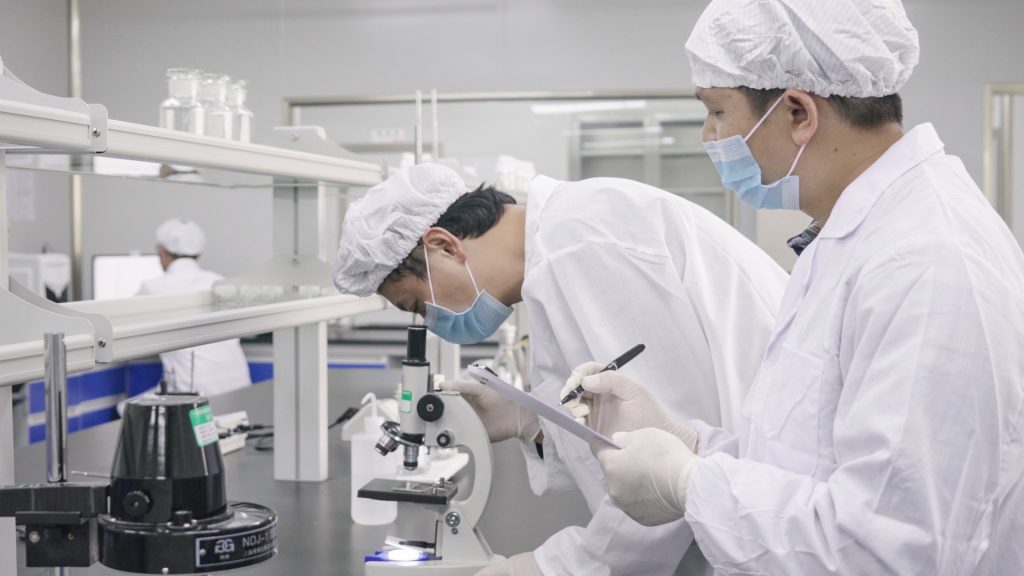
- Depth of Penetration: Using Confocal Laser Scanning Microscopy (CLSM) with fluorescent markers, we demonstrated that Huaxia’s nano-formulated serums achieved >85% deposition at the depth of the dermal papilla (approx. 2–3 mm) within 45 minutes. In contrast, control groups using traditional hair loss shampoos showed <10% penetration beyond the epidermis.
- Shedding Reduction: In a 28-day double-blind study involving subjects with mild-to-moderate androgenetic alopecia, the group treated with our penetration-enhanced formula showed a 56.2% decrease in daily hair shedding (pull test results), compared to only 12% in the placebo group.
- Hair Density & Diameter: Trichoscan imaging after 8 weeks revealed a 27.5% increase in terminal hair count per cm² and a 19.3% increase in average hair shaft diameter, indicating a successful reactivation of dormant hair follicles and prolongation of the anagen phase.
- Biochemical Efficacy: Ex-vivo analysis of scalp biopsies confirmed a 72% inhibition of 5α-reductase Type II activity in the hair bulb, directly correlating with the reduced levels of DHT (dihydrotestosterone) locally.
Conclusion: Elevating Hair Care Standards Through Science
The future of hair loss treatment lies not in discovering new plants, but in mastering the science of delivery. Without effective molecular penetration, even the most expensive hair growth ingredients are rendered useless.
Guangzhou Huaxia Biological Pharmaceutical Co., Ltd. stands at the forefront of this technological shift. With our GMPC/ISO22716 certified facilities, patent-protected penetration systems, and a robust pipeline of anti-hair loss solutions, we offer global partners a definitive advantage. We invite hair care brands, distributors, and R&D labs worldwide to partner with us. Let us move beyond surface-level claims and deliver true hair restoration results through the power of advanced transdermal science.
Contact Huaxia Biological today for technical specifications, clinical data reports, and OEM/ODM collaboration opportunities.
