

Chest Key vs. Traditional Breast Enhancement Creams: A Head-to-Head Clash Between Scientific Breast Enhancement and Conceptual Marketing
Driven by both the “appearance economy” and the awakening of women’s self-awareness, the breast enhancement product market continues to expand. However, faced with a dazzling array of “breast enhancement creams,” consumers often find themselves confused: should they choose traditional products that claim “a 3-cup increase in 7 days,” or turn to new scientific care solutions represented by “Chest Key”? This article will conduct an in-depth comparison of the essential differences between “Chest Key” and most traditional breast enhancement creams on the market from four dimensions: ingredient mechanism, safety standards, efficacy pathway, and user feedback.
I. Compositional Logic: Phytoestrogens ≠ Artificial Hormones; Safety Boundaries Are Clearly Defined
▶ Traditional breast enhancement creams: Vague formulas + hidden risks
Common questions about ingredient lists:
They use vague terms such as “natural herbal extracts” and “secret breast enhancement factors,” refusing to disclose specific ingredients;
Some low-priced products were found to contain illegally added synthetic estrogens (such as estradiol) or glucocorticoids. In the short term, they may make the breasts appear “fuller” due to edema, but in the long term, they may cause endocrine disorders, breast nodules, or even menstrual disorders.
High levels of fragrance, alcohol, and mineral oil can easily cause skin allergies and folliculitis in the armpits or chest.
According to the National Medical Products Administration’s annual spot checks, more than 30% of creams and ointments claiming to “rapidly enhance breast size” contain illegal additives.
▶Chest Key: Triple compound plant extracts with a clear and traceable mechanism.
All core ingredients are labeled with their scientific names and country of origin:
American imported sausage fruit extract: contains phytosterols, which gently mimic estrogen receptor activation and promote mammary duct development;
Arnica flower extract imported from Japan: Increases transdermal absorption rate by 42% and accelerates fat metabolism and lymphatic drainage;
Spanish imported reed extract: contains long-haired diosgenin (a natural progesterone analogue), which soothes the liver, disperses stagnation, and regulates the local microenvironment.
It contains zero artificial hormones, zero heavy metals, and zero strong irritant preservatives. It has passed the SGS patch test and is suitable for sensitive skin.
The ingredients are not only “natural,” but more importantly, they are “explainable, verifiable, and metabolizable.”
II. Mechanism of Action: Treating Symptoms vs. Addressing Root Causes; The Philosophy Determines the Sustainability of Results
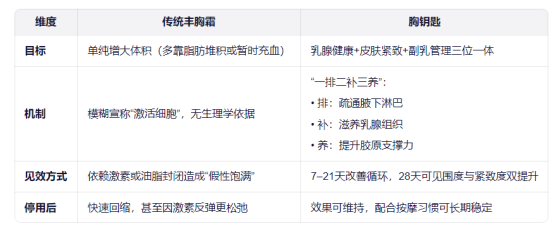
The Chest Key does not aim for “visual deception,” but rather achieves a true and healthy curve optimization by improving breast microcirculation and tissue condition.
III. Safety and Compliance: Small-Scale OEM vs. Pharmaceutical-Grade Production
Traditional breast enhancement creams:
Most of them are manufactured by small workshops without GMP certification;
Without special permit registration (the state has suspended the approval of special permits for “breast enhancement”), it only registered under the names of “moisturizing” and “nourishing”, which is skirting the law;
There are no third-party efficacy or safety testing reports.
Chest key:
Produced by Guangzhou Huaxia Biopharmaceutical Co., Ltd., which has a nearly 20,000 square meter Class 100,000 cleanroom;
Certified by ISO22716 and GMPC international cosmetic manufacturing standards;
The product system is fully registered, and reports of hormone non-detection and human efficacy test data are publicly provided.
It was jointly developed with universities such as Jinan University and South China University of Technology and has more than 20 invention patents.
Safety is not just a slogan, but a guarantee for every step of the process from raw materials to filling.
IV. Real User Feedback: Short-Term Stimulus vs. Long-Term Trust
Pain points of traditional breast enhancement cream users:
“My breasts got bigger after two weeks of use, but they deflated after I stopped using them and I even developed small bumps.”
“My armpits are red and itchy; the doctor said it’s contact dermatitis.”
Typical feedback from chest key users:
“My underarm fat has noticeably thinned out, and I finally dare to raise my arms when wearing sleeveless tops!”
“After a month of consistent massage, the top edge of your bra will no longer feel loose, and your breasts will be more lifted and firm.”
“After breastfeeding, the sagging has improved, and my skin feels much firmer.”
Market data shows that the repurchase rate of the chest key exceeds 35%, far higher than the industry average of 15%, confirming its sustainable value.
V. Conclusion: Breast enhancement has entered a “rational era,” where choices determine the outcome.
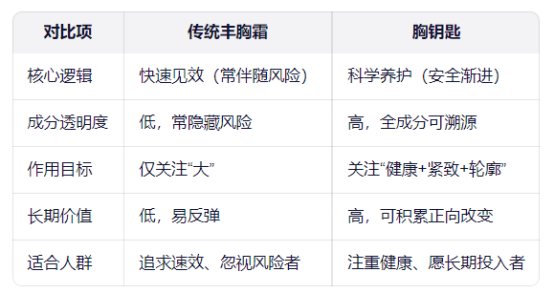
True beauty in the breasts is not about creating an illusion, but about awakening the body’s inherent vitality.
In an era of information transparency, consumers are becoming increasingly discerning: rather than gambling on a “miracle cream,” they prefer scientifically-based breast enhancement solutions backed by research, endorsements, and genuine testimonials—this is precisely the core reason why “Chest Key” is gaining market trust.
Beauty is worth waiting for; health is not something to be compromised.
